
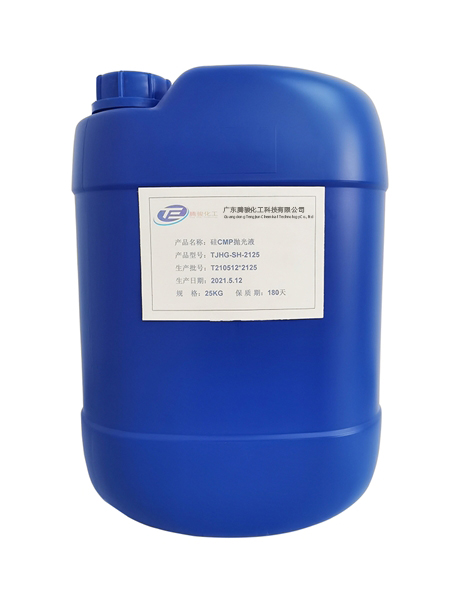
CMP (chemical mechanical polishing) slurry is a mixture of ultrafine solid abrasive materials and chemical additives used in planarization precision machining processes. CMP slurries generally consist of ultrafine solid particles such as nano-sized SiO2 and Al2O3 particles that provide abrasive action, and surfactants, stabilizers, and oxidants that provide corrosion and dissolution effects. It is widely used in the polishing processes of various integrated circuits, semiconductors, sapphire, LEDs, and other fields to assist in polishing and protect silicon wafers from scratches. Therefore, it is indispensable in the development of domestically produced chips. This article will analyze the current status and opportunities of the CMP slurry industry in China.
CMP technology is currently a sufficient condition for polishing silicon wafers in integrated circuits.
CMP technology works through a combination of chemical etching and mechanical abrasion. It utilizes the "soft abrasion, hard abrasion" principle, that is, using a softer material to polish a harder workpiece. Applying pressure and polishing slurry causes the workpiece to reciprocate relative to the polishing pad. Through the combined abrasive action of nanoparticles and the corrosive action of oxidants, a high-quality smooth surface is formed on the polished workpiece. This avoids the disadvantages of simple chemical polishing, such as slow polishing speed, uneven surface, poor polishing consistency, and surface damage caused by simple mechanical polishing.
Chemical mechanical polishing (CMP) technology is most widely used for polishing silicon wafers in integrated circuits (ICs) and ultra-large-scale integrated circuits (ULSI). Currently, it is generally accepted internationally that when device feature sizes are smaller than 0.35 μm, global planarization is necessary to ensure the accuracy and resolution of photolithographic image transfer, and CMP is currently almost the only technology that can meet this requirement.
Currently, CMP technology has evolved into a system technology centered on chemical mechanical polishing machines, integrating online inspection, endpoint inspection, and cleaning processes. It arose from the development of integrated circuits towards thinner, planarized, miniaturized, and multilayered processes. It is also an essential process technology for the transition to larger wafer diameters, improving productivity, reducing manufacturing costs, and achieving global substrate planarization.
As the most important component of CMP technology, the CMP polishing slurry generally consists of abrasives, pH adjusters, oxidants, dispersants, and additives such as deionized water.